Reading time: 6 minutes
“Our platform leverages cutting-edge AI technology with seamless cloud integration.”
If your eyes glazed over reading that, you’re not alone. It’s the kind of features-focused copy that tech companies love writing and customers love ignoring. Yet shifting to benefits-driven copy can transform not just your conversion rates, but your entire market position.
Don’t believe me? Let’s look at how three tech giants revolutionised their fortunes by focusing on what customers actually care about: the benefits.
Apple: From Computer Specs to “1,000 Songs in Your Pocket”
The Feature-Heavy Era
Remember when Apple competed on processor speeds and RAM? In the late 1990s, their marketing sounded like everyone else’s: “Power Mac G4: 500MHz PowerPC G4 processor with Velocity Engine.”
Their market share? A dismal 3%.
The Benefits Revolution
Then on 23rd October, 2001, Apple launched the iPod. Apple could have said: “5GB hard drive, FireWire connectivity, 32MB of RAM.”
Instead, Steve Jobs stood on stage and said: “1,000 songs in your pocket.”
That’s it. Five words that painted a picture of your entire music collection going everywhere with you. No mention of gigabytes. No technical specifications. Just the pure benefit of musical freedom.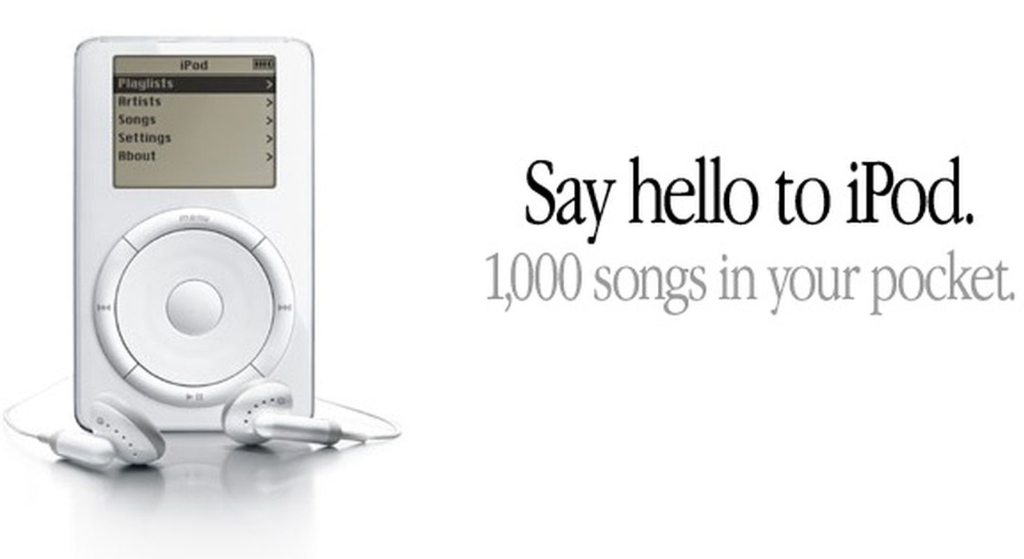
The Fortune That Followed
- iPod sales: Over 450 million units globally¹
- Market transformation: Apple went from near-bankruptcy to the world’s most valuable company
- The lesson: They stopped selling technology and started selling experiences
The Formula: Don’t tell me about the storage. Tell me how it changes my life.
Slack: From “Messaging Platform” to “Where Work Happens”
The Feature Trap
When Slack launched in 2013, the enterprise messaging space was crowded with tools listing features like “real-time messaging,” “file sharing,” and “search functionality.”
Slack had all these features. But so did everyone else.
The Benefits Breakthrough
Instead of competing on features, Slack focused on a simple benefit: making work life simpler, more pleasant, and more productive.
Their homepage didn’t list technical specifications. It promised: “Be less busy.”
Think about that. A productivity tool promising you’ll be LESS busy. It’s counterintuitive, brilliant, and entirely focused on the benefit users actually wanted.
Later, they evolved to “Where work happens” – again, not what the tool does, but what it enables.
The Numbers Tell the Story
- Growth: From 0 to 12 million daily active users in 5 years²
- Valuation: Acquired by Salesforce for $27.7 billion in 2021³
- Market dominance: Became the generic term for workplace messaging
The Formula: Don’t tell me about the features. Tell me about the better workday I’ll have.
Zoom: From “Video Conferencing Solution” to “Meet Happy”
The Technical Beginning
Pre-2020, Zoom was competing in a space dominated by technical giants like Cisco and Microsoft. Everyone talked about “HD video,” “screen sharing capabilities,” and “cloud-based architecture.”
Zoom had a different idea.
The Human-Centred Transformation
While competitors focused on enterprise features, Zoom’s copy focused on human benefits:
- “Meet Happy”
- “Flawless video. Clear audio. Instant sharing.”
- “It just works.”
Notice what’s missing? Jargon. Technical specifications. Feature lists.
Instead, every word focused on the emotional and practical benefits: happiness, flawlessness, simplicity.
The Pandemic Proved the Point
When the world needed video conferencing, they didn’t choose the platform with the most features. They chose the one that promised it would “just work.”
- Daily meeting participants: From 10 million (Dec 2019) to 300 million (April 2020)⁴
- Revenue: Increased 369% year-over-year in Q4 2020⁵
- Brand recognition: “Zoom” became a verb, like “Google” before it
The Formula: Don’t tell me about your technology. Tell me it won’t let me down.
The Psychology Behind the Success

Why do benefits work when features don’t? It’s simple neuroscience.
Our brains make decisions emotionally, then justify them rationally. Features appeal to rational justification. Benefits trigger emotional decisions.
When you say “256GB SSD,” the brain has to work to translate that into meaning.
When you say “Never delete a photo again,” the brain instantly understands the value.
The Benefits Blueprint: How to Transform Your Own Copy
Step 1: List Your Features
Write down every feature of your product or service. Be technical. Be thorough.
Step 2: Play the “So What?” Game
For each feature, ask “So what?” until you reach an emotional benefit.
Example:
- Feature: “Cloud-based storage”
- So what? “Access your files anywhere”
- So what? “Never lose work when switching devices”
- So what? “Peace of mind that your work is always safe”
- Benefit: “Sleep soundly knowing your work is protected”
Step 3: Lead with Benefits, Support with Features
Your headline should be the benefit. Features become supporting evidence, not the main story.
Instead of: “Advanced AI-Powered Analytics Platform”
Try: “Know what your customers want before they do”
(Then mention the AI in the supporting copy)
Step 4: Test Emotional Resonance
Read your copy aloud. Does it make you feel something? If not, you’re still in feature territory.
Common Objections (And Why They’re Wrong)
“But B2B Buyers Are Rational”
No, they’re human. They’re just better at post-purchase rationalisation. IBM’s “Nobody gets fired for buying IBM” wasn’t about server specifications, it was about job security.
“Our Competitors List Features”
Exactly. That’s your opportunity. While they’re boring prospects with specifications, you’re connecting emotionally.
“Technical Buyers Want Features”
Technical evaluators need features for comparison charts. But they’re rarely the final decision-makers. CEOs and CFOs buy benefits.
Your 5-Day Benefits Transformation

1: Audit your homepage. Count features vs. benefits. (Most companies run 80/20 features to benefits)
2: Rewrite your main headline using benefits only. Test it internally.
3: Transform your top three product descriptions from features to benefits.
4: Update your sales deck opening slides: lead with benefits, not capabilities.
5: A/B test your new benefits-focused copy against the original.
The Million-Pound Question
Here’s what separates the tech giants from the also-rans: They understood that customers don’t buy products. They buy better versions of themselves.
Apple didn’t sell MP3 players. They sold the soundtrack to your life.
Slack didn’t sell messaging. They sold calmer workdays.
Zoom didn’t sell video conferencing. They sold human connection.
What better version of themselves are you selling?
The Bottom Line
Every feature on your website is a missed opportunity to connect emotionally with your customer. Every specification is a chance to tell a story you’re not taking.
The tech giants figured this out. They transformed their fortunes not by building better features, but by communicating better benefits.
Your features might be impressive. But your benefits are what make the sale.
Ready to transform your features into benefits that actually sell? Let’s audit your current copy and uncover the fortune hiding in your features. Book a benefits breakthrough session with Joanna Aitkens at Aitkens Media.
For more copywriting insights and stories, you can sign up to my regular newsletter below
About the Author
Joanna Aitkens has spent 30 years helping technology and healthcare companies discover the benefits hiding behind their features. She has built a team that specialises in translating complex offerings into compelling human benefits that drive conversions and build brands.
Sources
1: Apple iPod Statistics 2025 – Wikipedia reports approximately 450 million iPods sold as of 2022
2: Slack Facts 2023 – Mimecast reports Slack reached 12 million daily active users by 2019
3: Salesforce Completes Acquisition of Slack – CNBC reports the $27.7 billion acquisition in December 2020
4: Zoom Daily Meeting Participants – Statista data showing growth from 10 million to 300 million participants
5: Zoom Revenue Statistics – Zippia reports 369% year-over-year revenue growth in Q4 2020
