Reading time: 8 minutes
The Advert Nobody Thinks About
Here’s a strange thing. Companies will spend thousands on brand guidelines, agonise over every word of their website copy, A/B test their email subject lines to death… and then publish a job advert cobbled together from a vague wish list, a looming deadline, and the fading hope that the right person will somehow find it anyway.
You know the ones. “Dynamic self-starter wanted for fast-paced environment.” Translation: we’re understaffed and chaotic. “Must have 5+ years’ experience with [tool that’s only existed for 3 years].” Translation: we copied this from another job spec without thinking. “Competitive salary.” Translation: we’re embarrassed to tell you.
Job adverts are marketing. They’re adverts. The clue is in the name. And yet, somehow, they’ve escaped the scrutiny we apply to every other piece of content our businesses produce.
It’s time to fix that and understand that job specs need copywriters too!
The Wish List Fantasy
Let’s start with the elephant in the room: the ridiculous requirements.
I recently saw a job spec asking for a degree, five years of experience, fluency in two languages, and advanced proficiency in about twelve different software platforms. The salary? Entry-level.
This isn’t recruitment. It’s a wish list written by someone who’s confused “ideal candidate” with “mythical unicorn.”
But when you ask for everything, you get nothing. The genuinely qualified candidates see that word-salad of requirements and think “they don’t know what they want”, or worse, “they want to underpay someone who’s overqualified for the job.”
Be straight with yourself. What do you actually need?
Is a degree really essential, or is it just a lazy shortcut for “someone who can write properly and think critically”? Is five years of experience genuinely necessary, or would an enthusiastic learner with the right attitude be just as valuable – perhaps more so, because they haven’t picked up someone else’s bad habits?
Some of the best people I’ve worked with were given a chance by someone who looked past the CV and saw potential. Sometimes what you need isn’t experience. It’s enthusiasm, loyalty, and a willingness to learn. Those qualities don’t show up on a tick-box list and they’re not limited by age either.
Where’s the Persona?
 If you work in marketing, you’ll know all about customer personas. That semi-fictional profile of your ideal customer outlining their needs, their challenges and what keeps them awake at night. You wouldn’t dream of writing a sales page without understanding who you’re talking to. So why do we throw all of that out the window when writing job adverts?
Your ideal candidate is a persona too. Not just a list of qualifications, but a real person with motivations, concerns, and options. What are they looking for? What would make them choose you over another employer? What’s going to make them stop scrolling and actually read your advert?
Think about it: a graduate drowning in student debt and living with their parents has very different priorities to a mid-career professional with a mortgage. Someone in a rural area without a car faces different challenges to someone in central London. A parent juggling childcare needs different flexibility to someone whose main commitment is a houseplant.
Who are you actually trying to attract? Write for them. Speak to their situation. Address their concerns before they even have to ask.
The Salary Silence
Can we take a moment to talk about the salary thing?
Hiding the pay is the recruitment equivalent of putting “price on application” on your products. It signals one of two things: either you’re planning to lowball people, or you haven’t actually worked out what the role is worth. Neither is a good look.
I understand the arguments. “We want to assess candidates first.” “Salaries are confidential.” “We’re flexible depending on experience.”
But here’s what candidates hear: “We’re going to waste your time.”
People need to know if a role is even financially viable before they invest hours in applications and interviews. Graduates struggling to find work while living at home can’t afford to chase roles that turn out to pay less than their commute would cost. Experienced, senior professionals aren’t going to jump through hoops only to discover you’re offering half their current salary.
Be upfront. If you’re genuinely flexible, give a range. If you’re embarrassed by the number, that’s useful information – maybe the budget needs revisiting before you start recruiting.
Transparency isn’t just kind. It’s efficient. It filters out the people who were never going to accept anyway, leaving you with candidates who are genuinely interested at the salary you’re actually offering.
Sell It Like You Mean It
 I’m assuming your company has a website, yes? Marketing materials? A carefully crafted message about why customers should choose you over the competition?
So why doesn’t your job advert communicate those same values?
Think about how much effort goes into selling your products or services. The benefits are front and centre. The value proposition is crystal clear. You anticipate objections and address them. You make it easy for people to say yes.
Now look at your job advert. Where’s the sell? Where’s the compelling reason to choose you as an employer? What’s in it for the candidate beyond “a job”? Too often, the answer is: not much. Vague promises of “flexible working” that evaporate under scrutiny. “Great team culture” with no evidence to back it up.
And then there are the “benefits” that aren’t really benefits at all. Team socials that happen in your own time and cost you money to attend. A Christmas party you have to pay £35 for. “Casual Fridays” as though wearing your own clothes one day a week is a perk rather than a minor concession. “Cycle to work schemes” for fully remote positions. “Unlimited holiday” policies that somehow result in people taking less time off than before.
If your benefits package wouldn’t survive being written as marketing copy for customers, it’s not a benefits package. It’s a list of things you’re hoping no one will examine too closely.
Some companies have genuinely thought about what would make a meaningful difference to their people.
McDonald’s
The home of the golden arches offers management trainees subsidies on gym memberships, groceries from various supermarkets, clothing and beauty brands, plus mental health support. In a world of rising living costs and eye-watering food prices, that’s a tangible, practical benefit that makes a real difference to people’s lives.
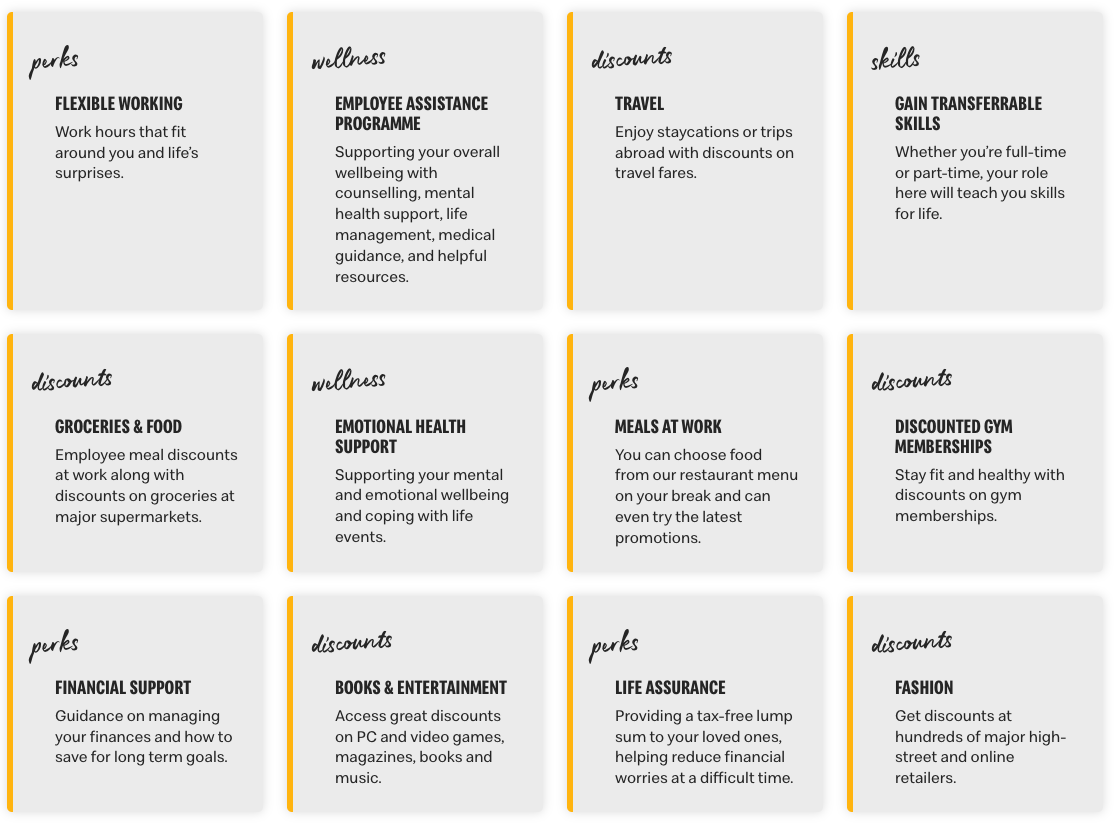
Example of McDonald’s benefits for employees.
Now, a caveat: not every business can offer big salaries or lavish perks. Small businesses, startups, charities have budgets that are tight and there’s no getting away from that reality. But this is where thoughtful writing becomes your secret weapon.
If you can’t compete on salary, what can you offer? Genuine flexibility – not the watered-down version, but actual control over when and where someone works? The chance to shape a role rather than fill a predetermined box? Direct access to leadership? Real variety in the work? A shorter commute, a dog-friendly office, a genuinely supportive team?
Think creatively. Be specific. “You’ll be our first marketing hire, which means you’ll have a say in everything from strategy to execution” is far more compelling than “opportunity for growth” – and it costs nothing to write.
And here’s something that might seem counterintuitive: a well-written job advert shouldn’t attract more applications. It should attract better ones.
When you’re specific about what you offer (and what you don’t), when you’re clear about who you’re looking for, when you’re upfront about the realities of the role, you filter out the people who were never right anyway. You spend less time sifting through hundreds of generic CVs and more time talking to the handful of candidates who read your ad and thought “yes, that’s exactly what I’m looking for.”
That’s the goal: not a flood, but a focused stream of people who actually want what you’re offering.
One final note: make sure your advert is legally compliant. Discrimination law applies to job adverts just as much as any other part of the recruitment process. If you’re not sure, get advice – it’s far cheaper than the alternative.
Plain English, Please
Job adverts have developed their own peculiar language. A sort of corporate word-salad that means nothing and sounds vaguely impressive.
“We’re looking for a passionate team player who thrives in a dynamic, fast-paced environment and can hit the ground running while thinking outside the box.”
What does any of that actually mean? Could anyone read that sentence and genuinely understand what the job involves or what kind of person would be good at it?
I remember hearing about an estate agent in London in the 1960s called Roy Brooks. Mr. Brooks became famous for writing property adverts with brutal honesty. While his competitors were calling broom cupboards “bijou flats,” Brooks would describe a house as needing “a lot of work” or note that the basement “floods regularly.” People loved it. The straight-talking cut through the noise and built trust.
Your job advert isn’t the place for corporate jargon or aspirational waffle. Say what the job actually involves. Describe what a typical day looks like. Be specific about the skills that matter and don’t fudge the challenges.
If the role involves dealing with difficult customers, say so. If the hours are long during busy periods, mention it. Is your office a bit chaotic, if so, own it. The right candidate will appreciate the candour; the wrong candidate will self-select out. That’s the system working exactly as it should.
When Someone Else Writes Your Ad
If you’re using a recruitment agency, here’s something worth thinking about: they’re writing marketing materials on your behalf.
That job advert goes out with your company name on it. It’s often a candidate’s first impression of who you are and what it might be like to work for you. And yet, how much time did the recruiter spend getting to know your brand? Do they understand your tone of voice? Have they spoken to anyone who actually does the job?
Content strategists and copywriters do this as a matter of course. Before writing a single word for a client, they’ll dig into brand guidelines, study existing materials, ask questions about culture and values. They know that sounding like the client isn’t optional – it’s the whole point. The goal is for readers to have no idea someone external wrote it.
Recruitment agencies should be doing the same thing. But too often, the briefing amounts to a job title, a list of requirements, and a salary range. The result? Generic ads that could be for any company in your sector. Ads that don’t reflect your personality, your culture, or what actually makes you a good employer.
If you’re outsourcing your recruitment advertising, treat it like you would any other piece of marketing. Provide brand guidelines. Share your tone of voice. Give examples of how you talk about yourselves. Your recruitment agency will appreciate the insights.
The Candidate Experience (Or: Please Stop Ghosting People)
 Here’s something that seems to get forgotten: the people applying for your jobs are people.
Some of them might be your existing customers. Some might become customers in the future. Their parents, partners, and friends are all potential customers too. Every interaction they have with your business – including the recruitment process – shapes their perception of your brand.
And yet, the standard candidate experience goes something like this: submit application into the void, receive automated acknowledgment (if lucky), hear nothing for weeks, eventually give up and assume rejection, never receive any closure.
This is a branding disaster.
Someone who has a terrible experience applying for a job at your company will tell people about it. They’ll remember how you made them feel. They’ll think twice before buying your products or recommending your services. And they’ll be right to.
Set realistic expectations. Tell people when they’ll hear from you, and then actually stick to it. If the process is going to take four weeks, say so. Explain upfront if there’s going to be an online test followed by two interviews. And if someone isn’t right for the role, tell them. A brief, kind rejection is infinitely better than silence.
Treat candidates like the potential customers they literally are.
The AI Elephant
We need to talk about AI in recruitment. It’s everywhere now, and it’s creating some peculiar problems.
First, there’s AI writing job specs. And look, I understand the appeal – it’s quick, it’s easy, and the output is grammatically correct. But AI-generated job adverts all sound the same. That same bland, enthusiastic-yet-meaningless tone. The same buzzwords in the same order.
If every job advert sounds identical, how is anyone supposed to tell what makes your role – or your company – different?
Then there’s AI screening CVs. The theory is that it saves time and removes bias. The reality is often keyword bingo: candidates gaming the system by stuffing their applications with the right terms, while genuinely brilliant people get filtered out because they described the same skills using different words.
I’ve heard of candidates being rejected by AI systems for roles they would have been perfect for, simply because their CV didn’t mention a specific phrase that the algorithm was hunting for. Meanwhile, less suitable candidates sail through because they’ve learned to write for the machine rather than for people.
AI can be a useful tool in recruitment. But it’s not a replacement for actual thought, and it’s certainly not a replacement for talking to candidates like they’re people rather than data points.
Trust Your Instincts (And Give People Chances)
Sometimes, you interview someone who doesn’t have the perfect CV. They might lack a qualification you thought was essential or have less experience than you’d ideally want. But something about them feels right. You get a sense that they’d fit, that they’d work hard, that they’d grow into the role.
Don’t ignore that instinct.
Some of the best hires are the ones who were given a chance by someone willing to look beyond the tick-boxes. People who were trusted, respected, and appreciated from day one – and who repaid that with loyalty and dedication that no amount of “relevant experience” can guarantee.
Recruitment isn’t just about finding someone who can already do the job. It’s about finding someone who could become exactly what you need. Sometimes the graduate without experience is hungrier and more teachable than the industry veteran going through the motions. Sometimes the career-changer brings fresh perspectives that your team desperately needs.
Give people chances. You might be surprised.
Your Better Job Advert Checklist
A few things to consider before you hit publish:
- Create a candidate persona – who are you actually trying to attract? What do they need to hear?
- Audit your requirements – is everything on your list genuinely essential, or just nice-to-have?
- Include the salary – range is fine, silence is not
- Cut the jargon – read it aloud; does it sound like a person wrote it?
- Describe the actual job – what will someone do day-to-day? Be specific.
- Set timeline expectations – when will candidates hear back? What does the process involve?
- Check your benefits – are they genuinely valuable, or just filler?
- Review against brand guidelines – does this advert sound like your company?
- Treat candidates like customers – because they might be or they already are
- Trust yourself – if someone feels right, they probably are
The Bottom Line
Job adverts are marketing materials. They deserve the same strategic thinking, the same careful copywriting, and the same brand consistency as everything else your business produces. They’re also often someone’s first interaction with your company. Make it a good one.
Be specific, clear and straight with people.
Write like you’re talking to an actual person, because you are. And remember that the best candidate might not be the one with the longest CV – they might be the one who just needs someone to believe in them.
✅ Hire a content strategist.
✅ Don’t fudge the details.
And please, for everyone’s sake, just put the salary in the advert!
Joanna Aitkens is a senior marketing strategist and copywriter who’s been helping businesses communicate clearly for 30 years. She works with clients in healthcare, technology, and science – and she’s seen quite enough job adverts asking for impossible combinations of skills at implausible salaries. Get in touch at hello@aitkensmedia.com or book a discovery call to talk through your project.
